


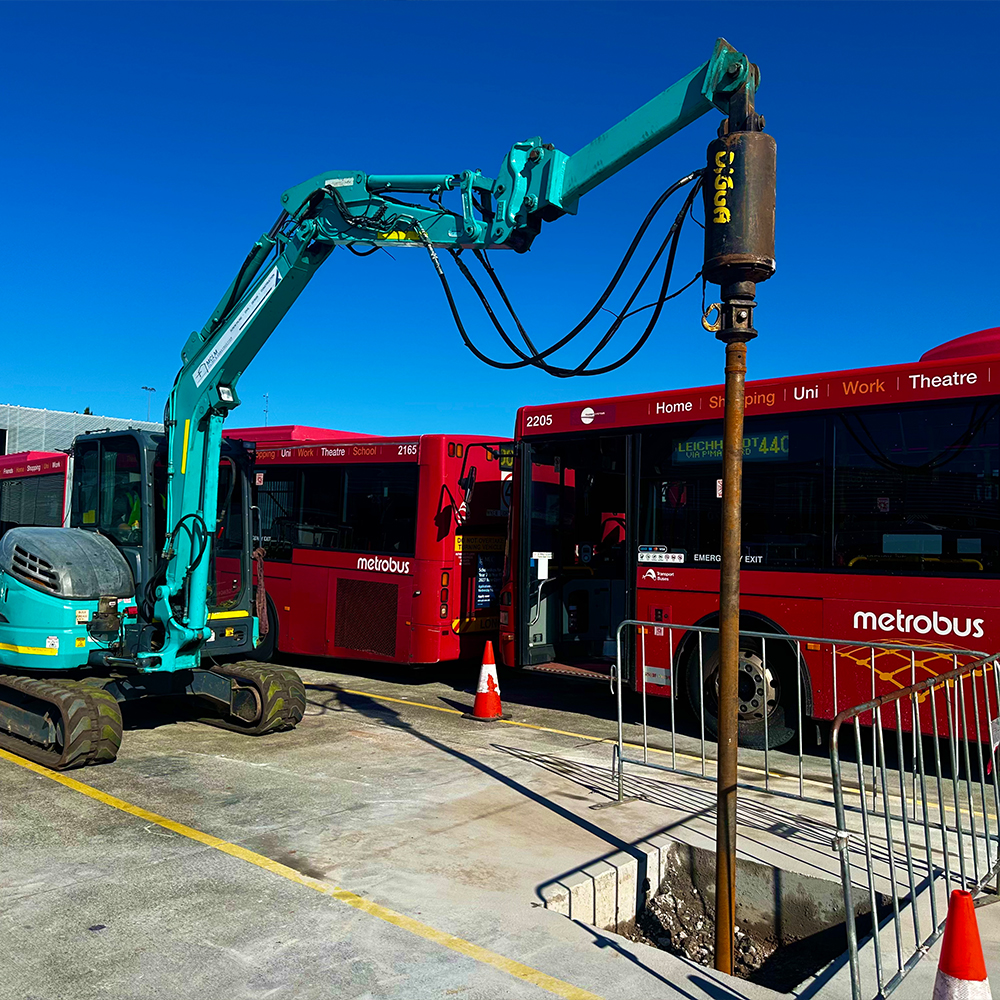
Why Hire Professional Screw Piling Contractors?
…and why a strong foundation decides everything
A project only performs as well as the ground it stands on. A well-designed, correctly installed foundation manages load paths, controls settlement, and protects the structure for decades. With screw piles, that outcome depends on more than a product,it depends on the people, process, and proof behind the install. Professional screw piling contractors bring in-house engineering, calibrated tooling, trained operators, and documented QA so every pile seats in the right layer at the right torque, delivering predictable capacity and program certainty.
What a specialist adds (beyond “just installing piles”)
Design integration: Engineers translate loads and geotech into the correct shaft, helix, and depth targets.
Depth confidence: DCP/test piling establishes realistic founding levels; real-time torque–depth logging verifies capacity as you install.
Tight tolerances: Verticality, embedment, cut-off and welding are controlled to spec, preventing rework at superstructure stage.
Program & site control: Rotary installation with no curing time keeps trades moving; low noise/vibration suits live, tight, or sensitive sites.
Full QA trail: As-builts, torque/depth logs, WPS to AS/NZS 1554, and compliance with AS 2159—so approvals are faster and risk is lower.
Safety, compliance, and certainty
Professional crews operate under documented ITPs and hold points, use calibrated torque equipment, and keep traceability on steel and helix components. Where required, static load testing confirms the design model on representative piles. The outcome is a foundation you can certify with confidence—no guesswork, no hidden liabilities later.
Why this matters to your build
Screw piles installed by specialists reduce unknowns: fewer weather delays, no bulk spoil, minimal disruption to neighbours and services, and immediate load-up so the program stays on track. That’s cost control you can measure in days saved, variations avoided, and defects that never appear.
How MCLM delivers
We own the process end-to-end—engineering, fabrication, and installation—so accountability is clear. Before steel hits site, we confirm ground with DCPs or test piles, then install with multiturn helix piles to the specified torque window. Every pile is logged, inspected, and signed off; where needed, we prove capacity with static testing. With a modern fleet and experienced crews, we routinely deliver working loads up to 2,000 kN, matching the demands of residential additions through to major commercial and public projects.
FAQs (screw-pile specific)
Reaching the correct bearing layer and hitting the design torque window, with installation recorded and certified. That combination gives reliable compression, uplift, and lateral performance.
By front-loading investigation (DCP/test piling), using calibrated torque systems, and enforcing install tolerances. If ground varies, we extend and continue to the torque window—no guesswork.
Yes. Rotary installation is low noise, essentially vibration-free, and produces no bulk spoil—ideal around services, neighbours, schools, and operating facilities.
An engineer-certified QA pack: torque/depth logs for every pile, as-builts, material traceability, and welding to AS/NZS 1554; designs and installation aligned with AS 2159.
On higher-risk or higher-load projects, or where ground is variable. Static compression/uplift tests on representative piles validate the capacity model and de-risk production.
Because we specialise in screw piles. Our multiturn helix system, in-house engineering, and documented QA deliver capacity and schedule certainty—foundations ready to build on, first time.

You might also like
-
What Are Screw Piles & How Do They Work? https://www.mclmgroup.com.au/wp-content/uploads/2025/08/IMG_2983-1024x768.jpg 1024 768 admin https://secure.gravatar.com/avatar/02f80a498427234de8b44a9e04731a49?s=96&d=mm&r=g
-
How Does Incorrect Pile Depth Affect Different Piling Methods? https://www.mclmgroup.com.au/wp-content/uploads/2025/08/IMG_6845-1024x768.jpg 1024 768 admin https://secure.gravatar.com/avatar/02f80a498427234de8b44a9e04731a49?s=96&d=mm&r=g
-
Foundation Assurance: Expert Screw Pile Testing Solutions by MCLM Group https://www.mclmgroup.com.au/wp-content/uploads/2023/12/Screenshot-2023-12-07-at-4.20.40-pm-1024x567.png 1024 567 admin https://secure.gravatar.com/avatar/02f80a498427234de8b44a9e04731a49?s=96&d=mm&r=g
Leave a Reply