


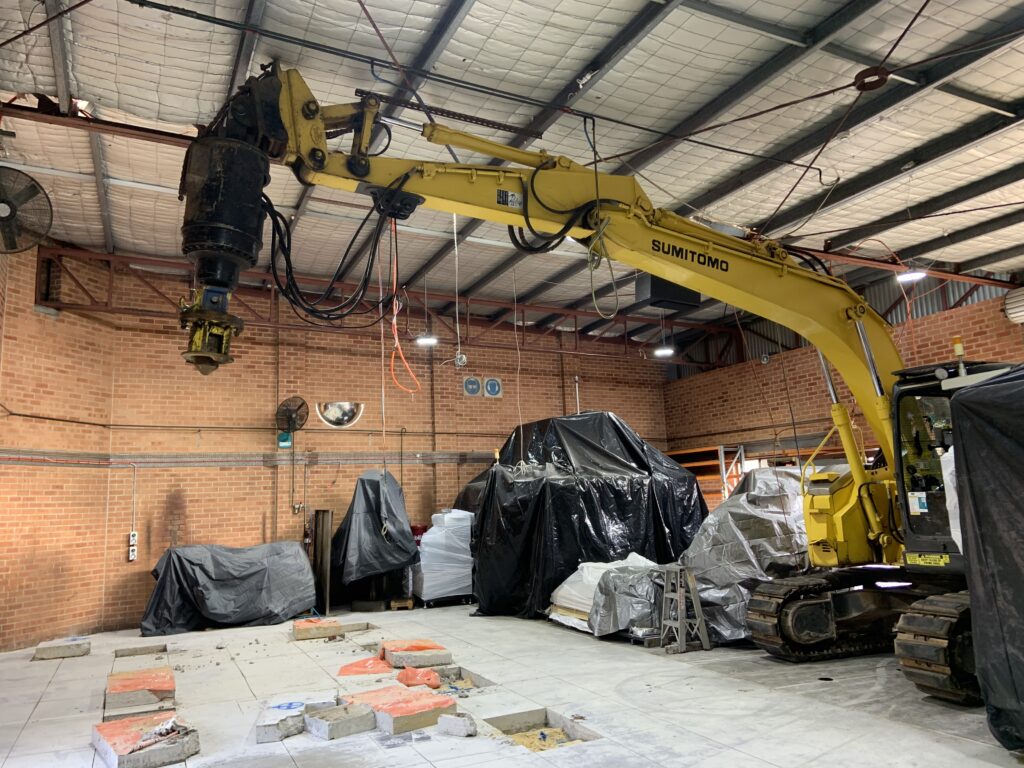
What Are Screw Piles & How Do They Work?
Screw piles are steel foundation elements installed by controlled rotation—think of a giant screw advancing into the ground. Each pile has a helical section at the toe that “bites” into competent soil. As the pile turns, the helix mobilises end-bearing and, with our multiturn helix design, compacts the surrounding soil to create a pressure bulb that spreads load efficiently. Capacity is confirmed in real time through the installation torque achieved in the target layer, so piles can be loaded immediately—no curing, minimal spoil, and low noise or vibration. This makes screw piles ideal for tight, live or environmentally sensitive sites where speed, cleanliness and predictability matter.
Why Screw Piles Are So Effective
Speed & program certainty: Rotary installation with no curing time keeps builds moving.
Clean delivery: Little to no bulk excavation or spoil, fewer truck movements, tidier sites.
Low disturbance: Low noise and essentially vibration-free, protecting neighbours and services.
Adaptable capacity: Installation torque correlates with pile capacity, so designs can be verified on site.
Multiturn advantage: Our conical, multi-flute helix forms a pressure bulb, often achieving required capacity at shallower depths and penetrating shaly/rocky horizons with less pre-drill.
Where Screw Piles Excel (Applications)
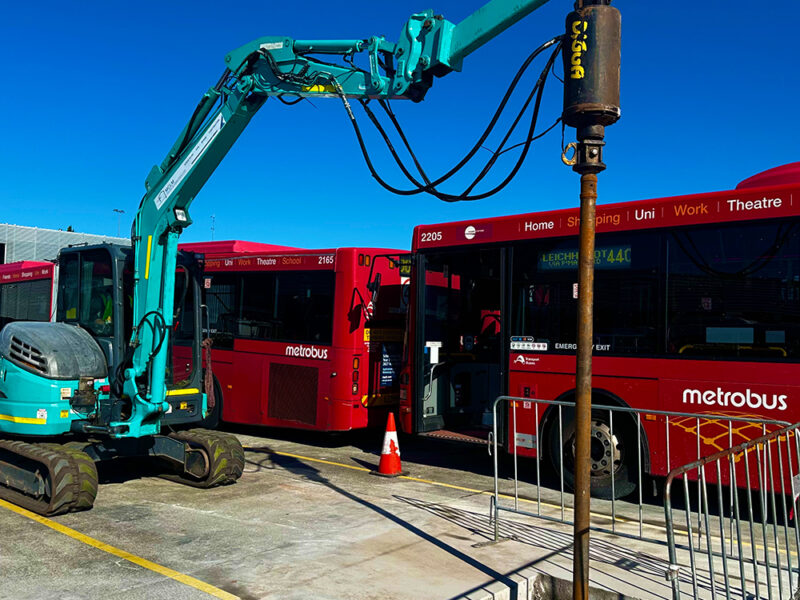
From small additions to major infrastructure, screw piles cover the lot: residential dwellings and extensions, retaining walls and decks, solar and light poles, warehouses and logistics, schools and aquatic centres, high-rise/mixed-use towers, government facilities, boardwalks, bus depots and parking structures. With pile solutions from 50 kN to 2,000 kN, MCLM scales capacity to suit the ground and the load.
What Controls Performance?
Soil profile: Sands, clays, silts and mixed fills respond differently; the goal is seating the helix in the right stratum.
Moisture & groundwater: Wet conditions change resistance; screw piles still install reliably without de-watering.
Helix geometry: Multiturn helix increases effective bearing area via the pressure bulb.
Depth & embedment: Capacity comes from reaching the layer that delivers the design torque window.
Installation quality: Calibrated torque, correct crowd/rotation, verticality, and documented hold-points.
Sustainability & Site Impact
Screw piles minimise excavation, cart-away and disturbance. Fewer truck movements and a smaller laydown footprint reduce fuel use and emissions. Piles can be removed or extended if design changes, making them a more environmentally responsible alternative to deep excavations and wet concrete works.
How MCLM Delivers Screw Piling Done Right
We handle the process end-to-end—engineering, fabrication, and installation—so accountability is clear and QA is tight. Before production, we can run DCP testing and test piling to forecast founding depths. During installation we record torque–depth logs for every pile; where specified, we prove performance with static load testing (compression/uplift). Our multiturn helix piles are manufactured and welded to stringent standards, and we supply full QA packs and engineer certification on completion.
FAQs (Straight Answers)
Primarily through end-bearing at the helix; our multiturn helix also compacts soil to form a pressure bulb that distributes load efficiently. Torque achieved during install confirms capacity.
Yes. Rotary installation is largely weather-independent, effective in high water tables, and needs no de-watering. In mixed strata, test piling and real-time torque control keep outcomes predictable.
Immediately. There’s no concrete curing, so superstructure works can proceed as soon as piles are installed and signed off.
We add extensions via couplings and continue to the torque window in the correct layer. This is planned for in our hold-points and QA process.
We deliver working solutions from 50 kN to 2,000 kN, matched to your loads, ground conditions and program.
Piling codes/ Compliance( Quality Control)
- All Multiturn helix are manufactured in Welded Cast Steel to ASTM WCB 216 Grade and come with NATA certified Test Certificates for Chemical Composition, Tensile Testing and Dimensional Tolerance Testing.
- All Pipe is API 5L/AS-1163 C350 350+ Grade Black Steel
- AS 2159-2009 Piling code
- Welding specifications and procedures as specified in AS1554 WPS
- All MCLM Fabricators are ISO 9606 Qualified
- ISO 9001 Quality Management System

You might also like
-
Why Hire Professional Screw Piling Contractors? https://www.mclmgroup.com.au/wp-content/uploads/2025/08/nsw-busdepot-img.jpg 1000 1000 admin https://secure.gravatar.com/avatar/02f80a498427234de8b44a9e04731a49?s=96&d=mm&r=g
-
How Does Incorrect Pile Depth Affect Different Piling Methods? https://www.mclmgroup.com.au/wp-content/uploads/2025/08/IMG_6845-1024x768.jpg 1024 768 admin https://secure.gravatar.com/avatar/02f80a498427234de8b44a9e04731a49?s=96&d=mm&r=g
-
Foundation Assurance: Expert Screw Pile Testing Solutions by MCLM Group https://www.mclmgroup.com.au/wp-content/uploads/2023/12/Screenshot-2023-12-07-at-4.20.40-pm-1024x567.png 1024 567 admin https://secure.gravatar.com/avatar/02f80a498427234de8b44a9e04731a49?s=96&d=mm&r=g
Leave a Reply